The Birthplace of SETI
On a recent vacation, my wife and I were driving through West Virginia and saw that Green Bank Observatory wasn't far from our itinerary. We drove through the rolling countryside to the remote location. The Observatory is within the National Radio Quiet Zone, where there are no cell towers, forcing us to use paper maps for about two hours each way. It was worth the drive; we had a fascinating tour of the radio telescopes from a guide knowledgeable in the history of their use for the SETI program.
In 1960, astronomer Frank Drake initiated Project Ozma at Green Bank, marking the first modern SETI experiment. Using the 85-foot (26-meter) Tatel telescope, Drake aimed to detect interstellar radio signals from intelligent extraterrestrial sources. He focused on two nearby Sun-like stars, Tau Ceti and Epsilon Eridani, scanning the 1.42 GHz frequency associated with neutral hydrogen—chosen because hydrogen is the most abundant element in the universe. Although the project did not detect any extraterrestrial communications, it laid the groundwork for future SETI endeavors.
The following year, Green Bank became the gathering place for a historic meeting of scientists interested in the search for extraterrestrial life. This conference is where Frank Drake introduced the now-famous Drake Equation. The equation attempts to estimate the number of active, communicative extraterrestrial civilizations in the Milky Way galaxy. By considering factors such as the rate of star formation, the fraction of stars with planetary systems, and the likelihood of life developing intelligence and technology, the Drake Equation has become a cornerstone in astrobiology.
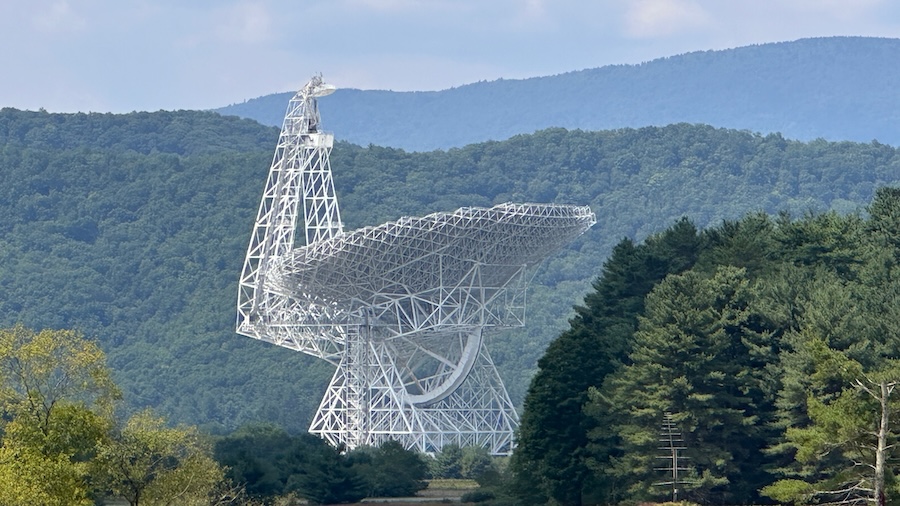
Over the decades, the observatory has played a crucial role in SETI research. Its location within the National Radio Quiet Zone offers an environment free from radio frequency interference, essential for detecting faint cosmic signals. The Green Bank Telescope (GBT), completed in 2000, is the world’s largest fully steerable radio telescope and has been instrumental in various SETI projects. Its advanced capabilities allow astronomers to conduct deep and comprehensive sky scans, increasing the chances of detecting potential signals from intelligent life.
Also on view as you enter the Observatory, the first radio telescope ever built. An amateur radio operator built it in his mother's backyard and convinced the professional astronomy community to add the study of the radio sky to their traditional optical surveys.